Christchurch, via Aoraki Mount Cook (20–24 March 2024)
We’d already seen Aoraki Mount Cook from the west side during our visit to Franz Josef, but weren’t going to pass up an opportunity to visit it again from another vantage. InterCity has a Queenstown to Christchurch route that takes a bit of a detour to visit Mount Cook village, so that’s what we booked. This turned out to be one of the biggest savings of our Intercity Flexipass: if we’d booked the trip as a tour it would have cost NZ$350 each, but on the Flexipass it cost twelve hours, or just under NZ$100 each at our hourly rate.
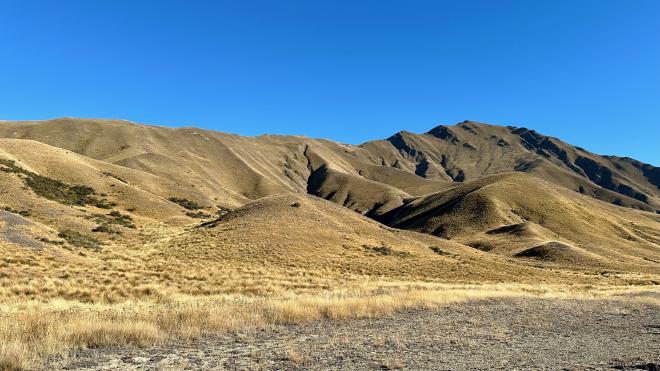
The bus headed east along the reverse of the route we’d taken coming from Franz Josef, then continued north-east at Cromwell and we were into new territory. We had a few stops along the way for toilet and photo breaks. These hills are in Ahuriri.
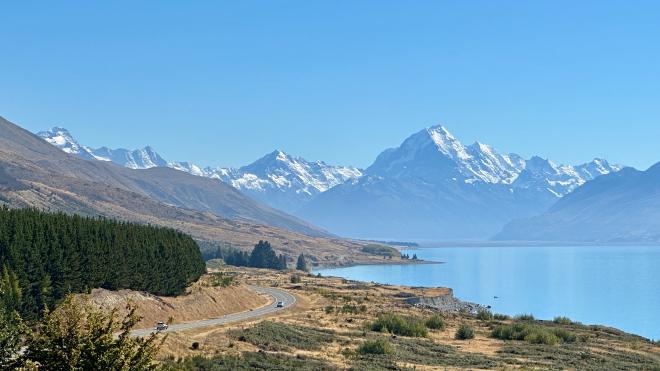
Our first good view of Aoraki Mount Cook was from a lookout we stopped at by the side of Lake Ruataniwha.
The bus stopped in Mount Cook Village behind the The Hermitage hotel, which is just across from the head of the trail to Kea Point Lookout. According to Google Maps the round trip was an hour and a half walk, and we had a two-hour stop. So we quickly bought some sandwiches in the hotel’s cafe and headed out on the trail.
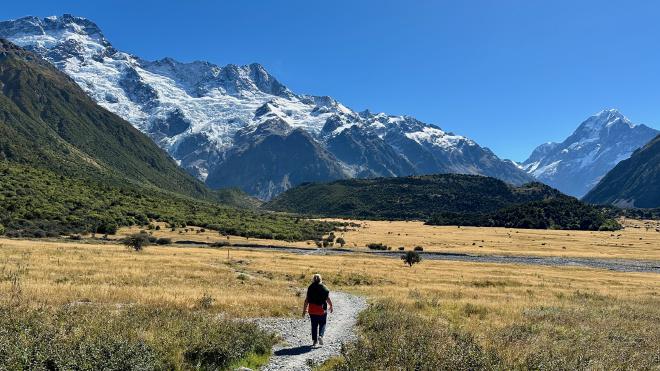
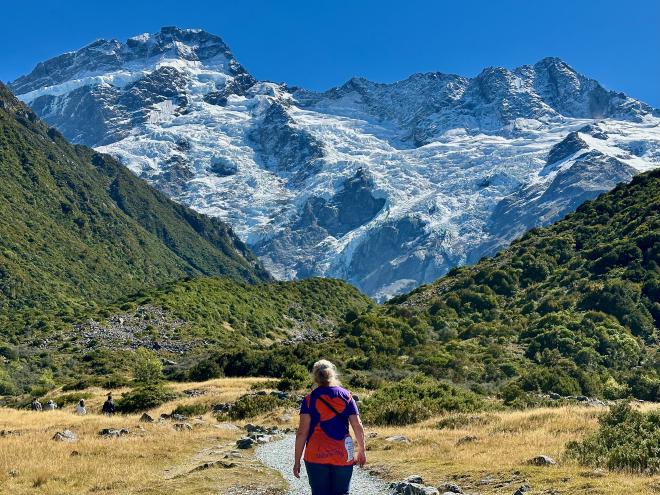
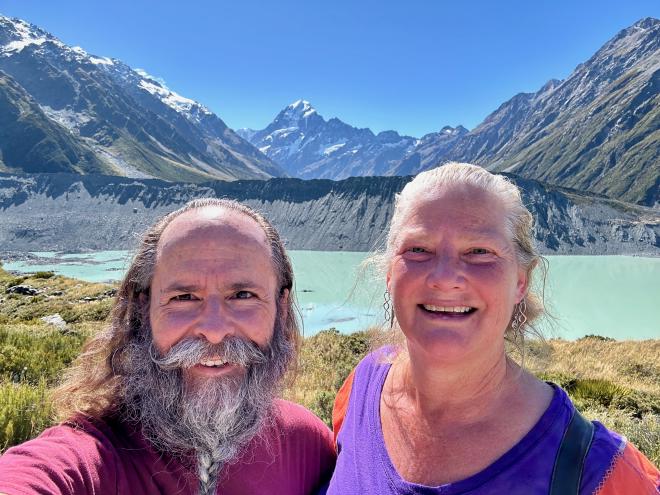
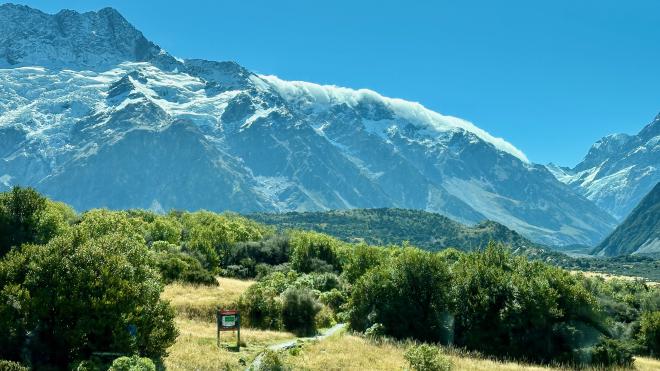
It was a gloriously sunny day and the air was crystal clear. In front of Karen, left to right, is Mount Sefton, the Huddleston Glacier, and a smaller peak called The Footstool.
After a very brisk thirty-five minute walk with lots of climb (Google’s prediction: forty-five minutes) we reached the lookout. We were a bit sweaty from the exertion, but since we’d made good speed we were able to have a nice lunch break and enjoy the view.
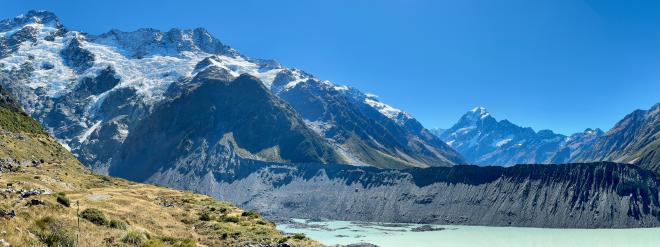
Speaking of which, here it is. At left, again, is Mount Sefton, the Huddleston Glacier, and The Footstool. The peak in the distance to the right of centre is Aoraki Mount Cook. In the foreground is Meuller glacial lake, and behind it is an enormous lateral moraine left behind by a retreating glacier.
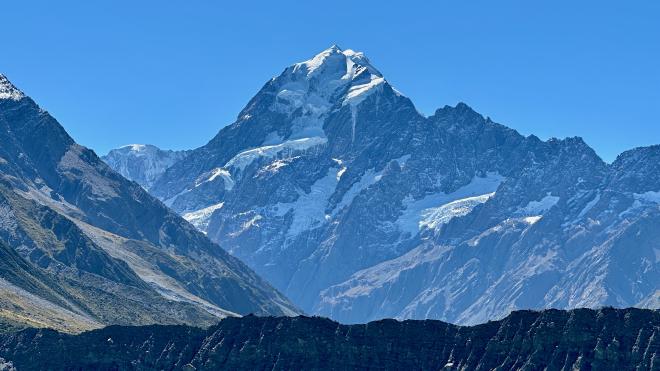
Here’s a closer shot of Aoraki Mount Cook. This view is from the south, so what you’re actually seeing is the lower of the mountain’s two peaks; the higher peak is hidden from this angle.
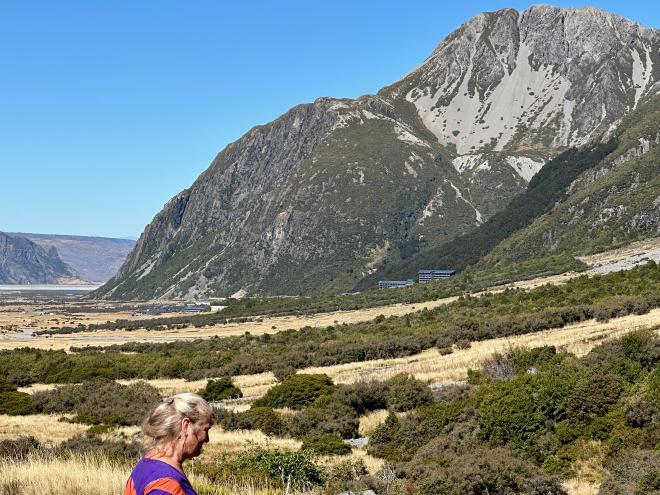
From the lookout we had a brisk walk back to The Hermitage, which is the large building just right of centre. According to local legend, Edmund Hillary, the first man to climb Mount Everest, decided to become a serious mountaineer in the bar of The Hermitage, when two other climbers came in from summiting Aoraki Mount Cook and became centre of attention for all the women.
As we pulled out of the hotel parking lot we could see the clouds starting to roll over the mountains – our timing had been perfect!
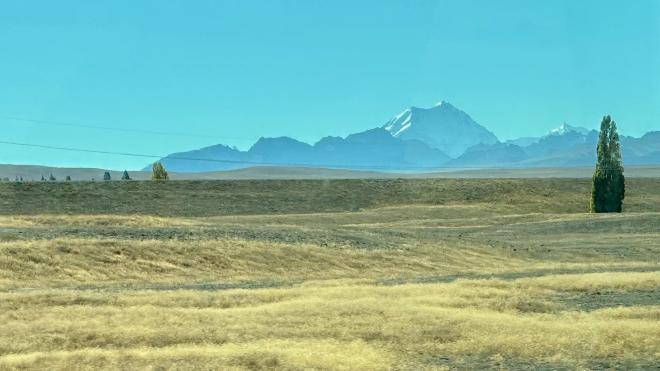
Here’s one last view of Aoraki Mount Cook, as viewed from the bus window. This angle clearly shows the mountain’s dual peaks.
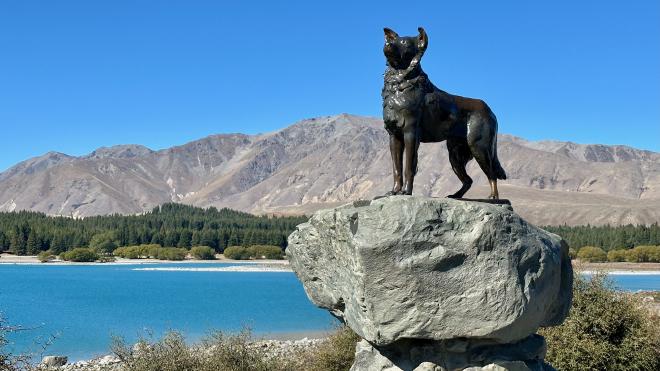
We had another rest and photo stop on the shores of Lake Tekapo, which is in Merino sheep country. This monument was erected “by the runholders of the Mackenzie County and those who also appreciate the value of the Collie dog, without the help of which the grazing of this mountain country would be impossible.”
Our bus arrived in Christchurch about 8 pm and we had a twenty-minute walk to the home we were staying in. Our hostess, a lovely woman named Jo, helped us get settled in, made us some herbal tea, and we had a nice chat. Then it was definitely time for bed.
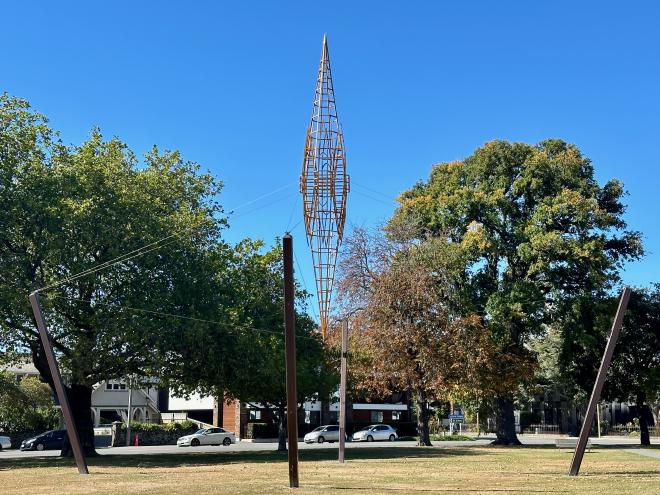
We decided to spend the next day walking Christchurch town centre and seeing some of the sights. This sculpture was in Latimer Square.
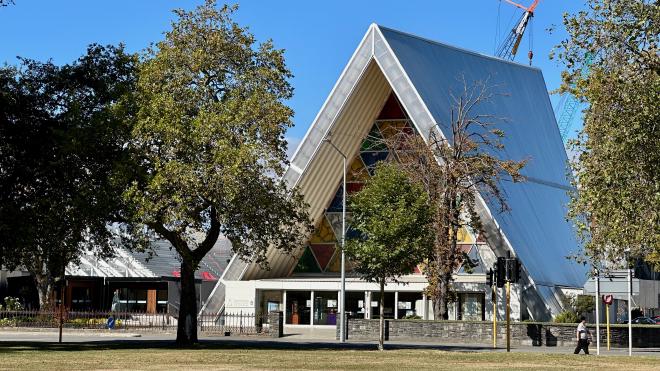
On the south edge of Latimer Square is the Transitional Cathedral. Christchurch suffered a major earthquake in February of 2011, which killed 185 people, injured many more, and damaged or destroyed many buildings – one which was Christchurch Cathedral. This building, designed by Japanese “emergency architect” Shigeru Ban, was constructed as a temporary replacement while the main Cathedral is being rebuilt. Once that opens, this building will become the parish church of St John.
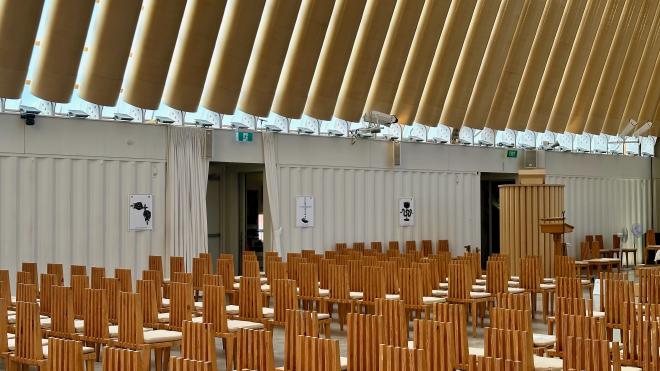
The Transitional Cathedral is better known as the “Cardboard Cathedral” because of its unusual construction. The base of its walls consists of standard shipping containers and its roof supports are reinforced cardboard tubes. The roof is translucent corrugated plastic, which lets through the light. The building took less than two years to complete and is expected to last at least fifty years. The Cathedral’s chairs were also designed by Shigeru Ban.
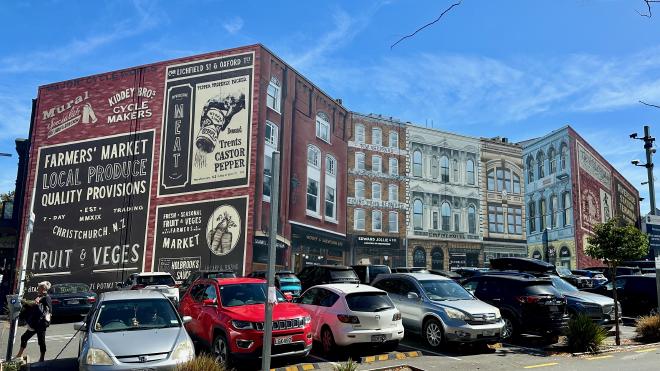
This is the Riverside Market, which houses food sellers, take-away restaurants, and a craft brewery. The wall you’re looking at is actually flat and featureless, but painted with a brilliantly-convincing Trompe-l’œil mural.
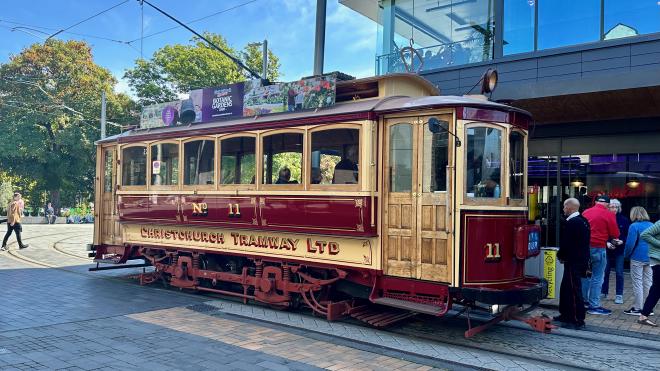
Formerly part of Christchurch’s public transport system, this tram now provides a hop-on hop-off tourist loop. We didn’t ride it, but we saw it several times in the downtown core since we walked just about everywhere it goes.
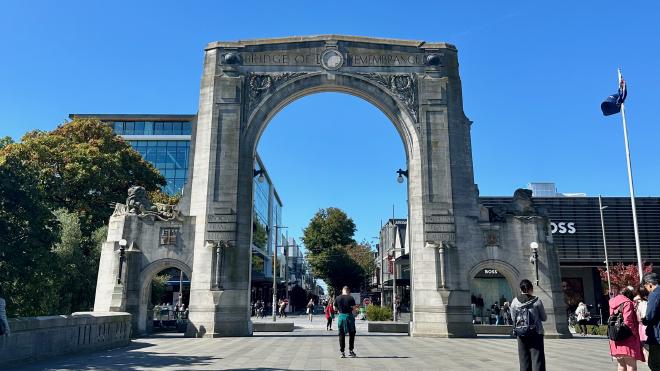
On the south-western edge of the central business district (which is referred to as “inside the four avenues”), is the Bridge of Remembrance memorial to the dead of World War I.
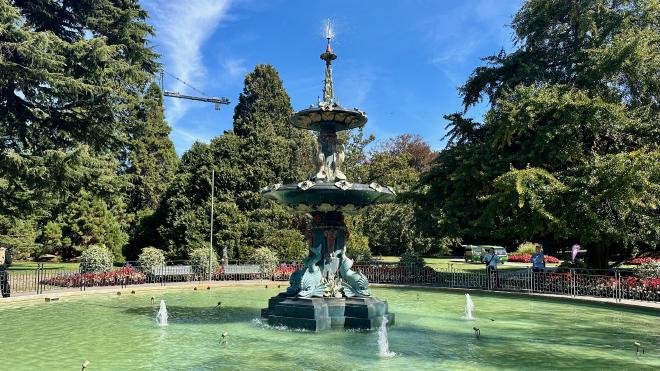
Just west of the bridge is the Christchurch Botanic Gardens, set in a loop of the Avon River and enclosed by Hagley Park. It features the Peacock Fountain, named for the businessman who donated the funding to buy it in about 1910. The fountain is made of cast iron, much of which had to be re-cast when the fountain was restored in the 1990s. It has been painted in a variety of colour schemes over the years, most recently in 2007.
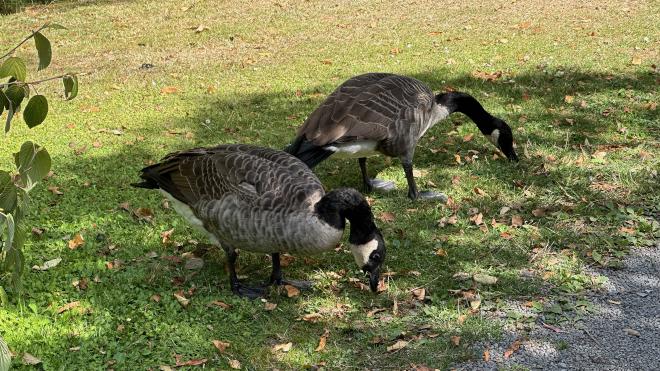
We weren’t the only Canadians in the gardens. However, we seemed to be welcome, while these guys were treated as invasive pests – just like we treat them at home.
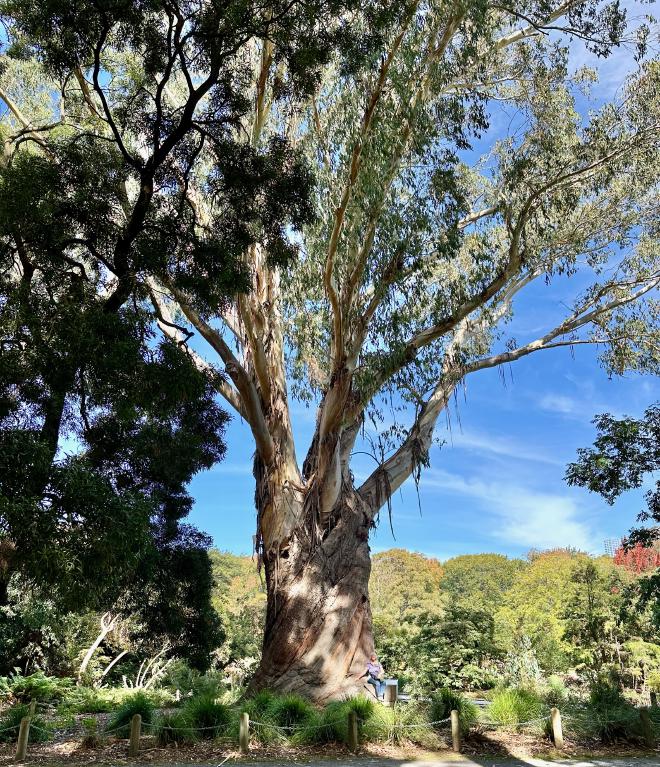
This Alpine Ash or Eucalyptus delegatensis was planted some time around 1913. Its trunk is 3.7 metres in diameter. The purple dot near its base is Karen, for scale.
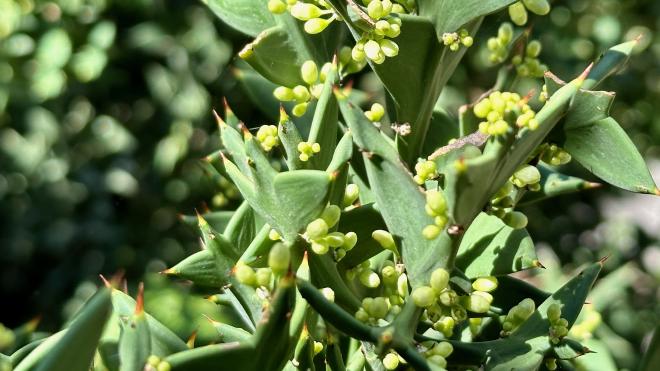
This Anchor Plant, named for the shape of its spines, is native of Chile and Argentina.
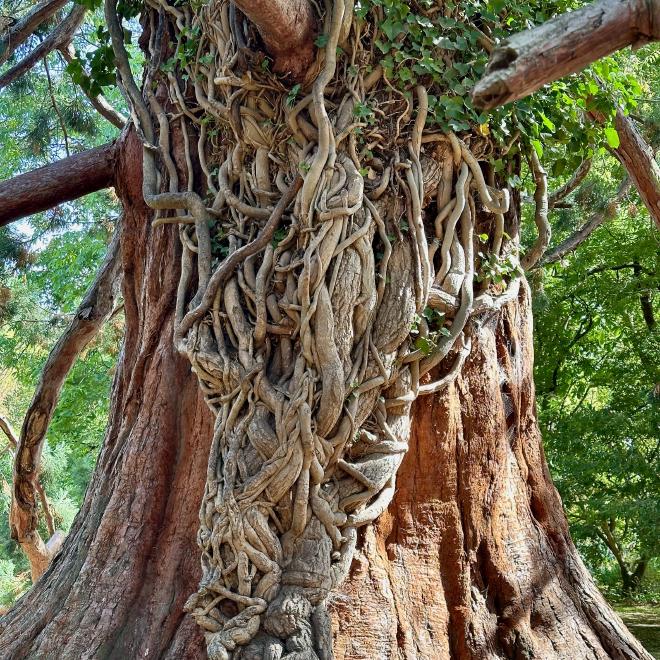
This tree had a rather impressive collection of vines growing up it. Both the vines and the tree appeared happy with the arrangement.
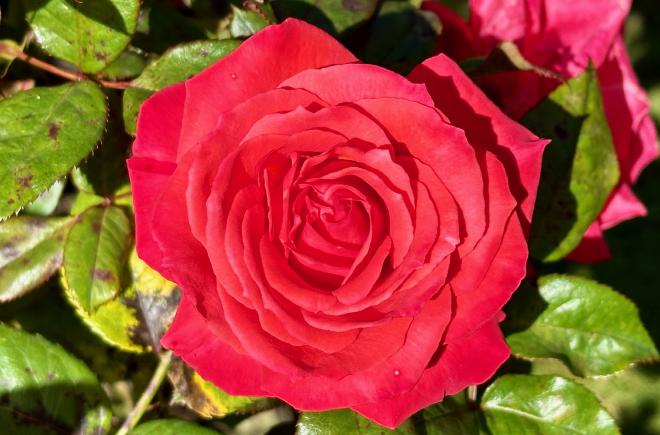
A rather perfect rose.
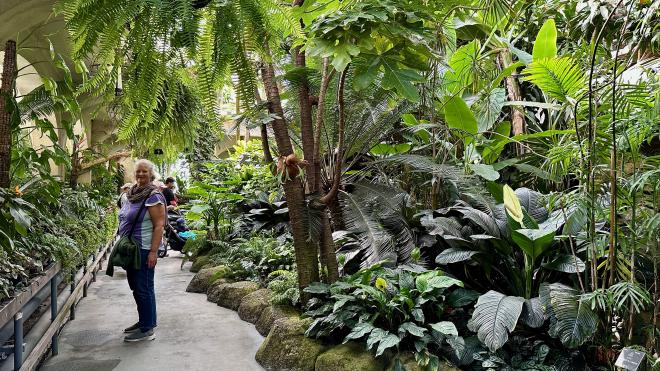
We managed to duck into the conservatories, stealthily avoiding a wedding party that was having pictures taken at the entrance.
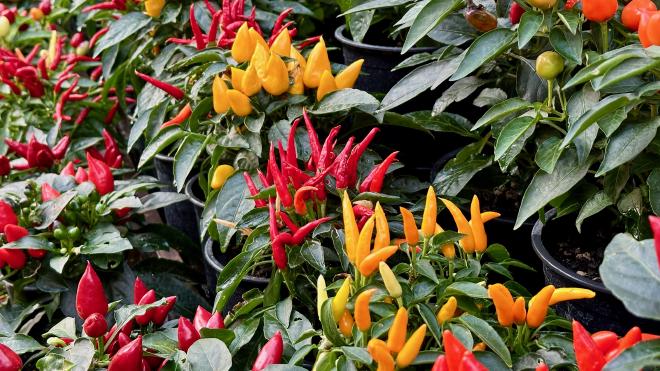
One room in the conservatory was all bright flowers and chilli peppers. To Greg’s dismay, the peppers had prominent “do not eat” labels.
This is part of Te Matatiki Toi Ora The Arts Centre, on what was formerly the School of Engineering of the University of Canterbury. There are 23 buildings on the site, all massively damaged in the 2011 earthquake. “… a total of 20 buildings.. have been completely strengthened, restored, and re-opened to the public. The insurance settlement is now exhausted…. A decision has been made to temporarily strengthen and mothball these two huge buildings for restoration in the future, potentially for the next generation to tackle.”
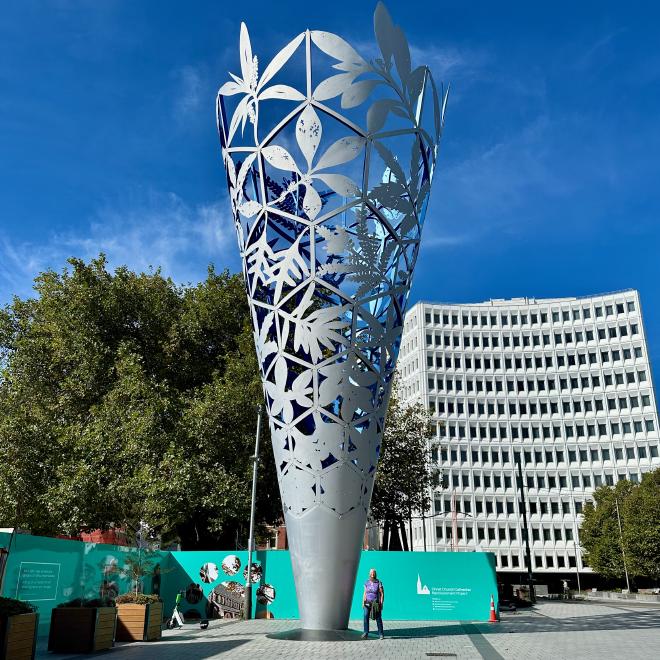
This massive sculpture on Cathedral Square, called The Chalice, incorporates leaves from mapou, kowhai, mahoe, totara, karamu, titoki, ngaio, maratata and koromiko.
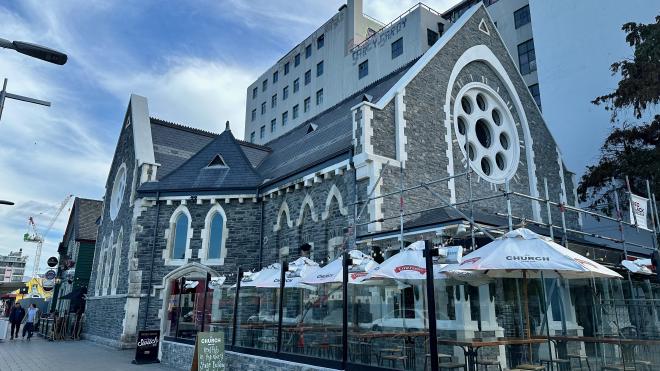
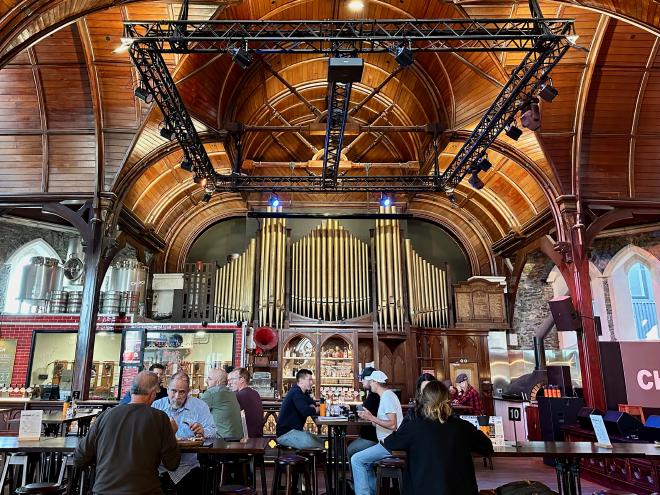
We finished our day at the Church Pub, which advertises itself as a “new pub in the oldest stone building in Christchurch.”
Much of the interior has been kept in its original state, including the vaulted wood ceilings and the pipe organ, now behind the taps. You can see part of the brewing system at left on the upper level.
The Canterbury Museum, which we’d walked past on our visit to the Botanical Gardens, is currently closed for a multi-year renovation. However, they do have a small pop-up exhibit on the upper level of the Centre of Contemporary Art, and we decided to pay that a visit.
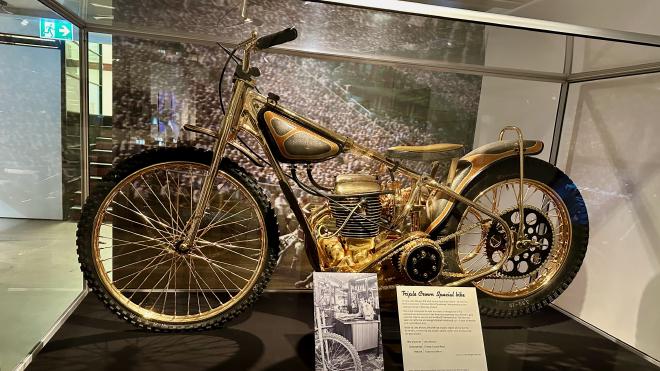
The exhibited artifacts are a bit of a fun, eclectic, mix. This is the motorcycle that Ivan Mauger rode to an unprecedented third consecutive Individual World Speedway Championship in 1970. Two American fans offered to have it gold plated, inside and out, which took a year and a half and cost half a million US dollars.
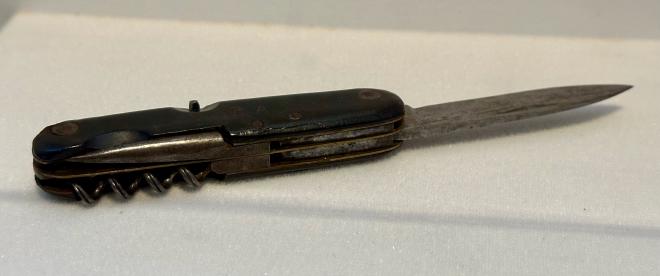
At the other end of the gaudy-to-practical spectrum we have Roald Amundsen’s pocket knife, which he used on the Norwegian expedition that became the first to reach the South Pole on 14 December 1911.
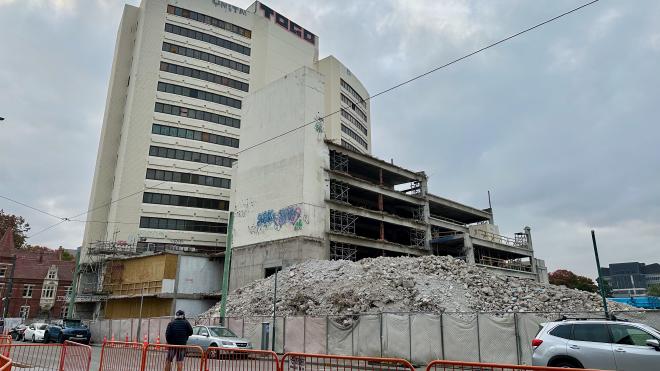
Walking back from the Museum exhibit we passed this apartment building to the north of Cathedral Square. It was declared unsafe following the 2011 earthquake and is only now being demolished.
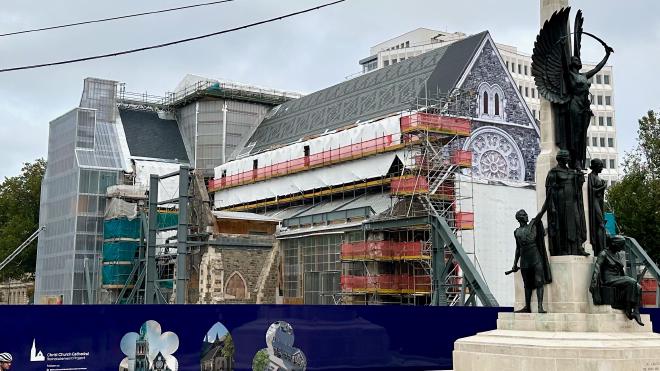
This is Christchurch Cathedral. Following the earthquake there was a prolonged and divisive debate about whether to tear it down and rebuild, or strengthen and restore the original structure. Ultimately the “restore” faction prevailed, with the result you see here.
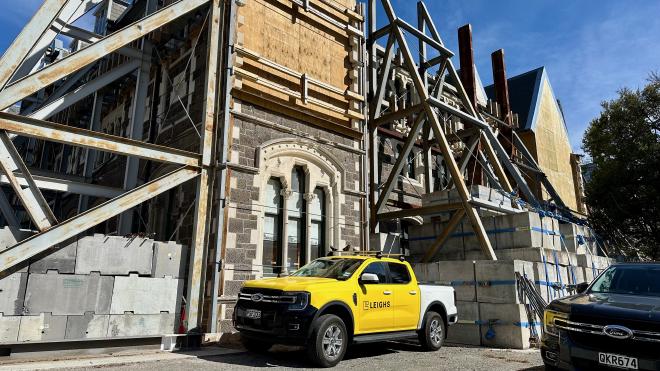
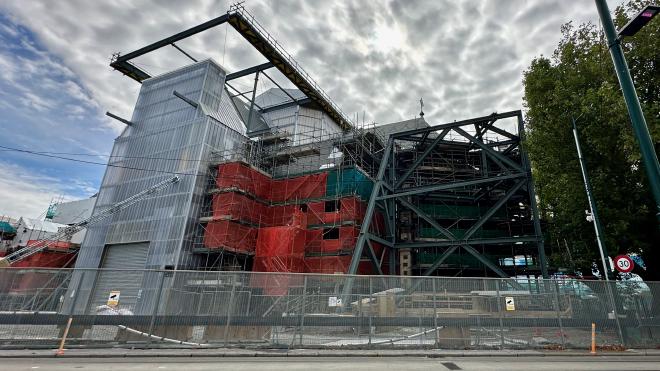
This is the rear of the Cathedral, showing the full extent of “temporary” structural bracing. According to the descriptions on the construction fence around the Cathedral, the plan is to have it re-opened in 2028. However, that plan also suggested that most of the external bracing would be gone by 2023, which clearly didn’t happen, so the plan may be optimistic.
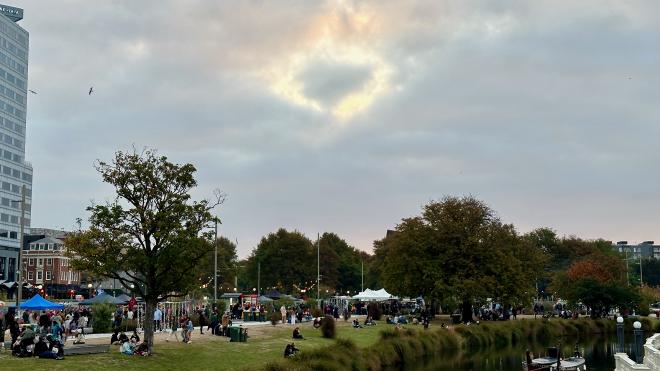
Walking back to our apartment after dinner we saw this unusual pattern of light in the clouds. At the left of the photograph is the Crowne Plaza Hotel, which survived the earthquake without irremediable damage and is one of the few tall buildings left in the city. The new building regulations don’t permit anything over seven stories.
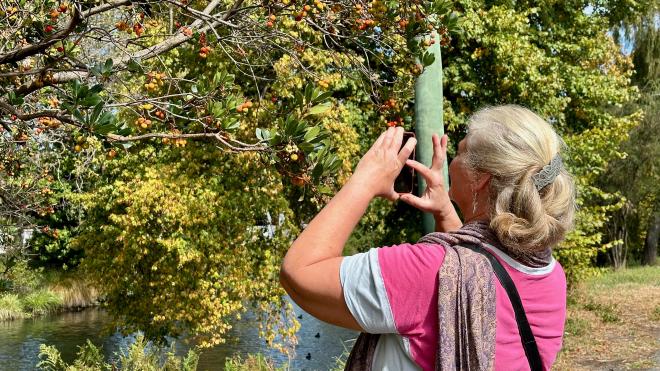
The next morning we decided to take a walk along the Avon River into the Residential Red Zone. Karen spotted some interesting berries along the way and needed a photograph.
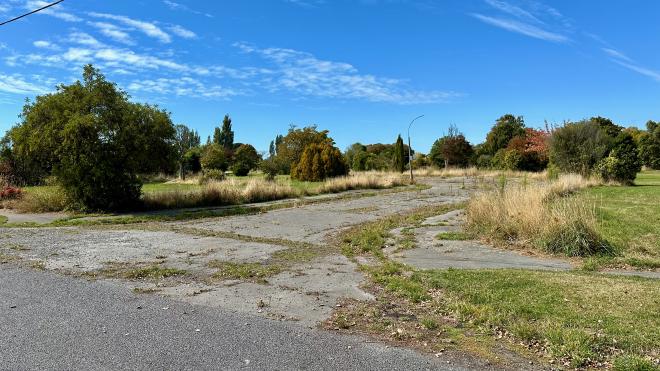
This is in the heart of the Red Zone, which is just a few kilometres along the Avon from Christchurch’s city centre. What you see here used to be a residential neighbourhood, all of which was torn down following the earthquake. This area, and a few others around the city, were declared too prone to soil liquifaction in an earthquake, and therefore unsafe to build on. The decision to relocate all the residents and declare the region uninhabitable remains controversial to this day.
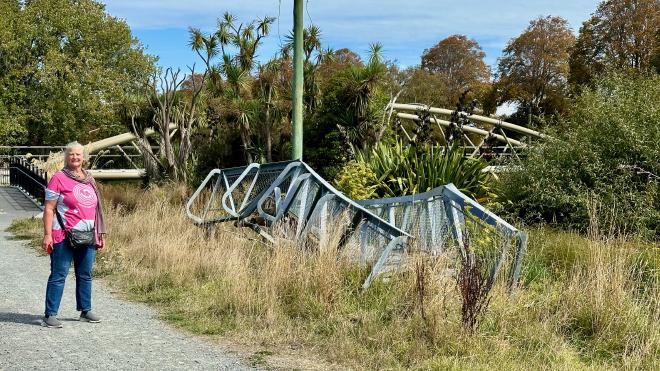
The twisted bit of metal beside Karen is part of the original Medway footbridge across the Avon, left as a memorial to the earthquake. Its rather highly-engineered replacement is behind her.
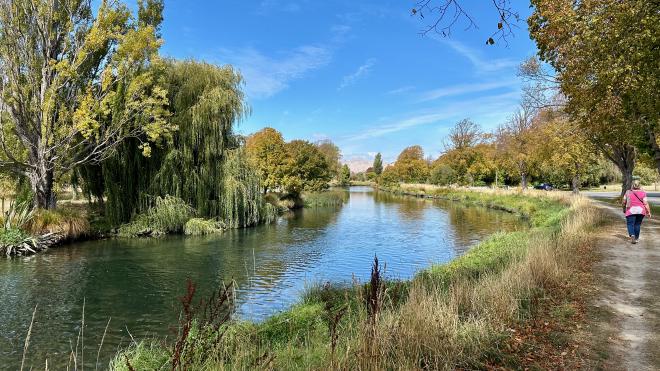
The walk along the Avon was quite lovely, despite the sombre context.
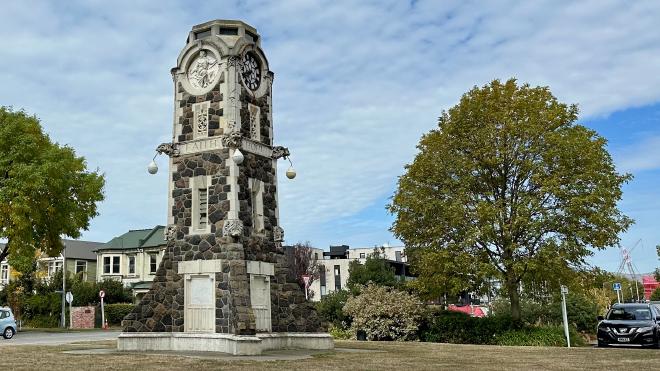
The Edmonds Clock Tower was donated to the city in 1929, damaged in the earthquake and then restored.
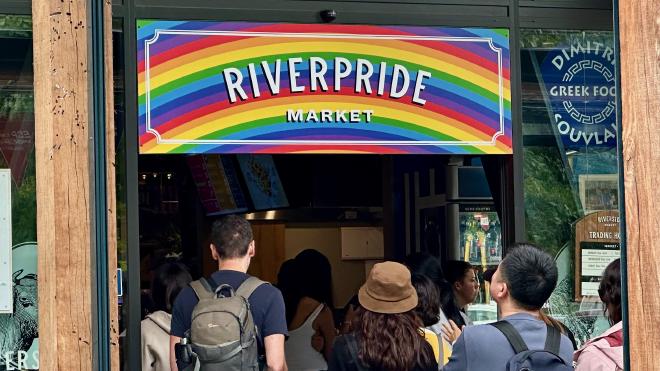
For dinner we decided to get take-away fish and chips from the Little Fish Co. in the Riverside Market. It was Pride month in Christchurch during our visit, which mostly seemed pretty low-key. One of the few obvious references we saw was the Market’s temporary rebranding.
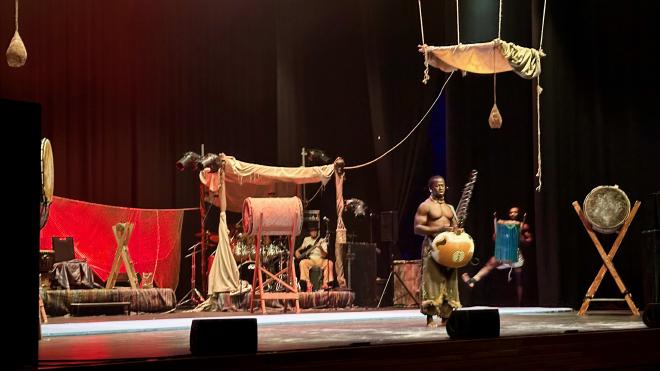
Our AirBnB hostess, Jo, had mentioned that she and a friend had tickets to see an Afrique en Cirque in the James Hay Theatre in Christchurch Town Hall. There were still a few tickets left, so we decided to grab two and join them. Jo invited us to join her and her friend for some wine in the living room, after which we walked to the theatre. The show featured live music, a lot of tumbling and acrobatics, a little juggling, and some of the most extreme and dynamic contortion we’ve ever seen. Afrique en Cirque is originally from Guinea, but based in Montreal.
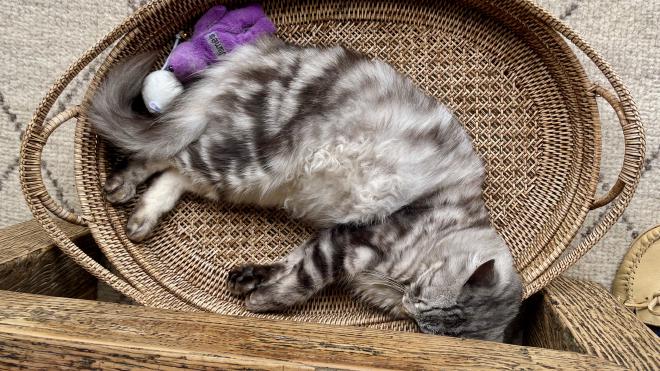
We decided to take our last day in Christchurch as a rest and maintenance day, most of which we spent in Jo’s living room under the close supervision of Harvey.
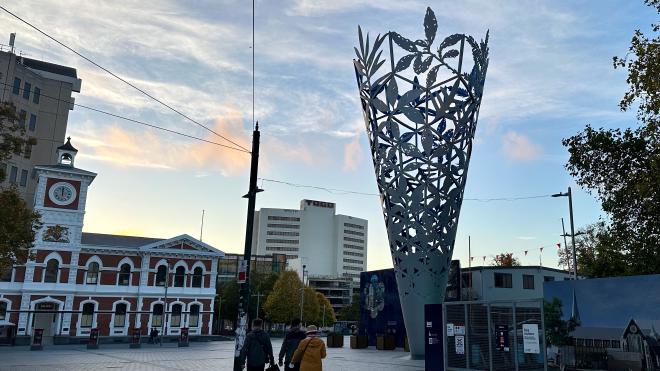
Our route to dinner took us through Cathedral Square again, letting us get a nice silhouette of The Chalice. The tall building in the distance is the one under demolition from a few photos back.
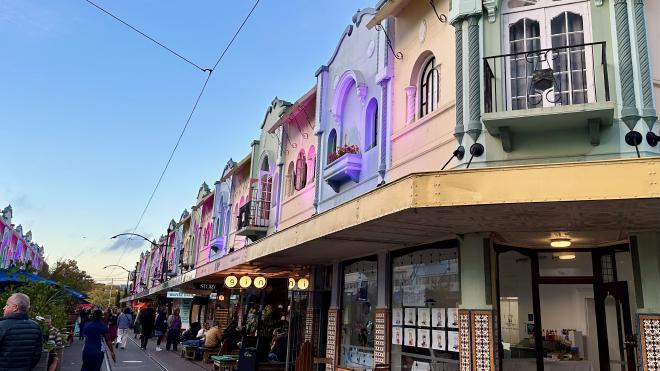
Regent Street is a charming pedestrian thoroughfare in the core, lined with shops and restaurants.
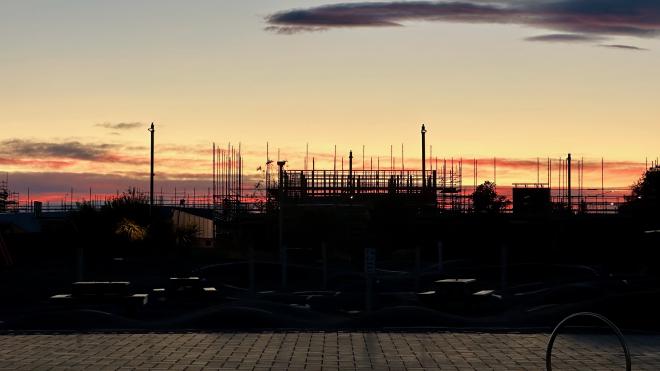
There was a spectacular deep red sunset that night, which nicely highlighted this new construction – a fitting symbol with which to end our time in Christchurch.
We had another early-morning bus the next day, and it was off to Dunedin.